

Another one. That is the soundtrack of 2026 in AI agent tools. xAI launched Grok Bot on August 11. CopilotKit shipped OpenBot about a week later as an open source take on the same coworker-with-a-computer pitch. Hermes, Buzz, and Herdr were already sitting on our machines. From a landing page they all look like a robot that does your job while you sleep. They are five different jobs wearing the same hoodie.

I am tired of installing the wrong one. This is the map we use in the shop so the next launch does not eat a Saturday.
They are not five harnesses
Most comparison posts pretend these products compete. They do not. One is a rented office. One is a self-hosted copy of that office. One is the agent that actually thinks. One is the group chat. One is tmux with a status light. Stack them wrong and you get four terminals, no memory, and a cloud VM full of shared passwords.
| Thing | Job | Unit | You own it? |
|---|---|---|---|
| Grok Bot | Managed AI coworkers | Named bot on a cloud computer | No. SuperGrok Heavy / Cursor Ultra / Teams Premium, early beta |
| OpenBot | Same idea, self-host | Bot plus Docker computer | MIT code. Threads still need CopilotKit Intelligence |
| Hermes | Agent OS | Session, tools, skills, cron | Yes. MIT, any model |
| Buzz | Town square | Message plus keypair | Yes. Apache 2.0. Chat, not a loop |
| Herdr | Pane farm | PTY / workspace | Yes. Apache 2.0. Does not think |
Grok Bot: the rented office
Grok Bot is xAI’s teammate product, not the Grok chat box with a new coat of paint. Each bot gets a persistent cloud computer with a browser, files, and a terminal. It signs into the apps you already use, including ones with no API worth calling. You message it from desktop or iOS like a coworker. It keeps going after you close the lid and only pings you for approvals. You can run several bots, put them in a group chat, and show one a workflow once so it saves a routine.
The catch is in their own sentence: bots share a computer of their own in the cloud. Files, browser sessions, and logins are a household, not apartments. Do not treat bot names as a security boundary. Access is gated to SuperGrok Heavy, Cursor Ultra, and Cursor Teams Premium. The macOS build even ships from Cursor’s download CDN. Closed, hosted, early beta. Polished. Not yours.
OpenBot: another one, with a Compose file
CopilotKit heard “another one” and built the open source clone. OpenBot is a React app and Hono API on your Postgres. Each bot can get its own Docker computer: Chromium, a workspace, a shell. Every browser, file, or MCP action hits a gateway first. Policy, then an audit row, then the click. That part is the interesting engineering. Fail closed CEL rules. A human can take the wheel for 2FA. Skills here are slash-prompt text, not capabilities.
It is alpha. v0.0.1. The one-container image is 5.3 GB and wants 2 GB of RAM as a floor, 4 GB if a few bots are browsing. One replica for now, because page snapshots live in process memory. A second container clicks ghosts. Threads and memory live in CopilotKit Intelligence, which needs a license token. So you self-host the app and still rent the conversation store. Per-bot isolation also needs a supervisor holding the Docker socket. Without that, every bot shares one browser. Same shape as Grok Bot’s shared computer, just in your rack.
Hermes: the brain that stays on
Hermes Agent is the thing we actually run 24/7. Nous Research, MIT, Python. It is an agent OS, not a coworker demo. Skills it writes and reuses. Memory across sessions. A gateway into Discord, Telegram, Buzz, and a pile of other chats. Cron. Kanban. Profiles. Any model you can point it at. Terminal, browser, files, MCP. It lives on a NAS or a cheap VPS, not on a laptop you close.
If Grok Bot is “message a teammate,” Hermes is “the teammate has a workshop, a filing cabinet, and a night shift.” Isolation comes from profiles, worktrees, and tool gates, not from hoping two named bots cannot see each other’s cookies.
Buzz: the town square
Buzz is Block’s self-hosted workspace where humans and agents share rooms. Nostr under the hood. Each agent is a keypair, not a pane. You @mention work across the relay. Hermes, Claude Code, Codex, extra profiles, whoever showed up with a key. The relay is the message bus. It does not think. It does not run a browser. It has no native timer, which is why we fire Buzz workflows from Hermes cron.
Closest overlap with Grok Bot is the group chat of named bots. Difference: Buzz is a protocol you host. Grok Bot’s bot-to-bot chat is a closed version of that idea on one vendor computer.
Herdr: tmux that knows who is stuck
Herdr is not an agent. It is the runtime coding agents live on. Workspaces, tabs, panes. A sidebar of working, blocked, idle, done. Sound when one wants a yes or no. Detach the client and the herd keeps going on that machine. Crash the client, same story. Crash the server and you get the layout back. CLI conversations resume only if the native resume hook fired. Dev servers do not.
Use it when the pain is four live Claude Code / Codex / Grok TUIs and you cannot tell which pane is waiting on you. Skip it on a NAS that is already an always-on gateway. Herdr hosts the TUIs. It does not replace Hermes or Buzz.
How to pick without a spreadsheet
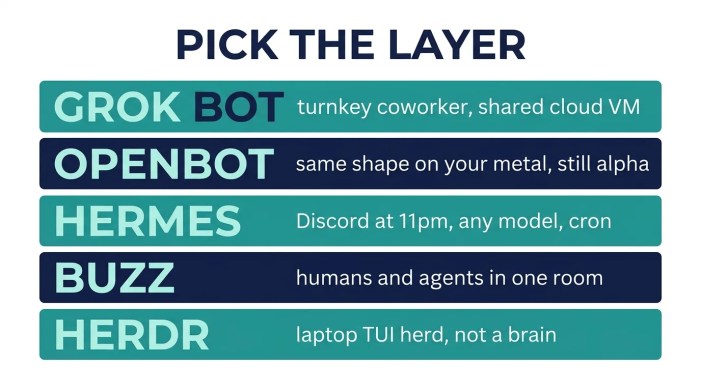
Want a turnkey coworker and you will accept one shared cloud VM plus a Cursor-tier bill? Grok Bot.
Want that coworker shape on your metal, and you will babysit Docker, Postgres, and a CopilotKit thread store? OpenBot. I would not, not this week, not in alpha.
Want an agent that lives in Discord at 11pm, remembers the house, runs cron, and is not married to one vendor model? Hermes.
Want humans and agents in the same room with portable identities? Buzz.
Want a laptop full of coding CLIs that keep running when you walk away? Herdr.
What I run
Hermes on docker as my daily driver and assistant. It was my main tool for all my home projects and Antigravity IDE when I needed to dig into the code and generate things. Then Buzz came along. Now it’s the team that my Hermes can pass our plans to and our agents can start building. Haven’t tried Herdr yet but might only if the laptop TUI herd becomes the actual pain. Grok Bot is the polished rental of a pattern we already have. OpenBot is another one of the same pattern with a Compose file and a vendor memory sidecar. We did not stand either of those up. We read the docs, compared them to production, and kept the stack that already answers at 2am.
Next week there will be another one. What an exciting time in AI.
